Let's name what's actually happening
Here's the thing about anxiety and arousal: they live in completely opposite nervous system states. Arousal requires your body to relax, trust, and build sensation. Anxiety requires your body to be on high alert, scanning for threats, muscles tight. You can't do both at the same time. Your brain won't let you.
So when you're sitting with your partner or alone, wanting to feel turned on, and instead your mind is racing through your to-do list or replaying an awkward conversation from this morning, that's not a you problem. That's a nervous system problem. And that's exactly what a lemon vibrator can help reset.
Why anxiety shuts down arousal (and why it's not your fault)
When you're anxious, your sympathetic nervous system is active. That's the fight-or-flight branch. Blood is being diverted to your limbs to help you run or defend. Your digestion slows. Your pelvic floor tightens. Sensation in your genitals becomes muted because your body literally doesn't think this is a safe time for that.
Meanwhile, arousal needs your parasympathetic nervous system. That's rest-and-digest. Blood flows to your genitals. Your muscles relax. Your sensitivity sharpens. Your mind can focus.
When you're anxious, you're locked out of that state. And no amount of willpower fixes it. You can't think your way out of it. You can't push through it.
What you can do is give your body a signal strong enough to interrupt the anxiety loop. That's where sensation comes in.
How targeted sensation interrupts the anxiety spiral
A lemon clitoral vibrator works because it's specific, rhythmic, and immediate. When you activate a lemon sucker on low intensity, you're sending your nervous system a clear signal: something good is happening right now, in this body, in this moment.
That rhythm creates what's called a "competing stimulus." Your brain can't hold both "I'm anxious about work" and "I'm experiencing focused pleasure" simultaneously. One has to win. Usually, the sensation wins because it's more concrete and present.
The suction pattern of a lemon vibrator is particularly useful here because it works differently than traditional vibration. It creates a steady, building sensation that encourages blood flow to the clitoris and gradually pulls your nervous system out of fight-or-flight. You're not trying to relax. You're just responding to what your body is feeling.
The practical setup for anxiety-driven arousal loss
If you're using a lemon clitoral vibrator while managing anxiety, timing and environment matter more than usual.
Find a window of lower anxiety, not zero anxiety. You don't have to feel completely calm. But a moment when the panic isn't peak (maybe right after you've finished something on your to-do list, or after a walk) gives you a head start.
Eliminate decision-making. Anxiety and choices don't mix. Set yourself up fully before you start. Lube ready, toy ready, phone in another room. Your brain can't hold arousal while also deciding what to do next.
Start with low intensity and let it build. Don't jump to pattern 3 on your lemon vibrator. Stay on 1 or 2 for at least 5 minutes. You're not chasing orgasm. You're teaching your body that this is a safe time to respond.
Use a grounding anchor. Many people with anxiety find that focusing on the physical sensation while placing one hand on their heart or stomach helps. You're literally anchoring yourself to the present moment.

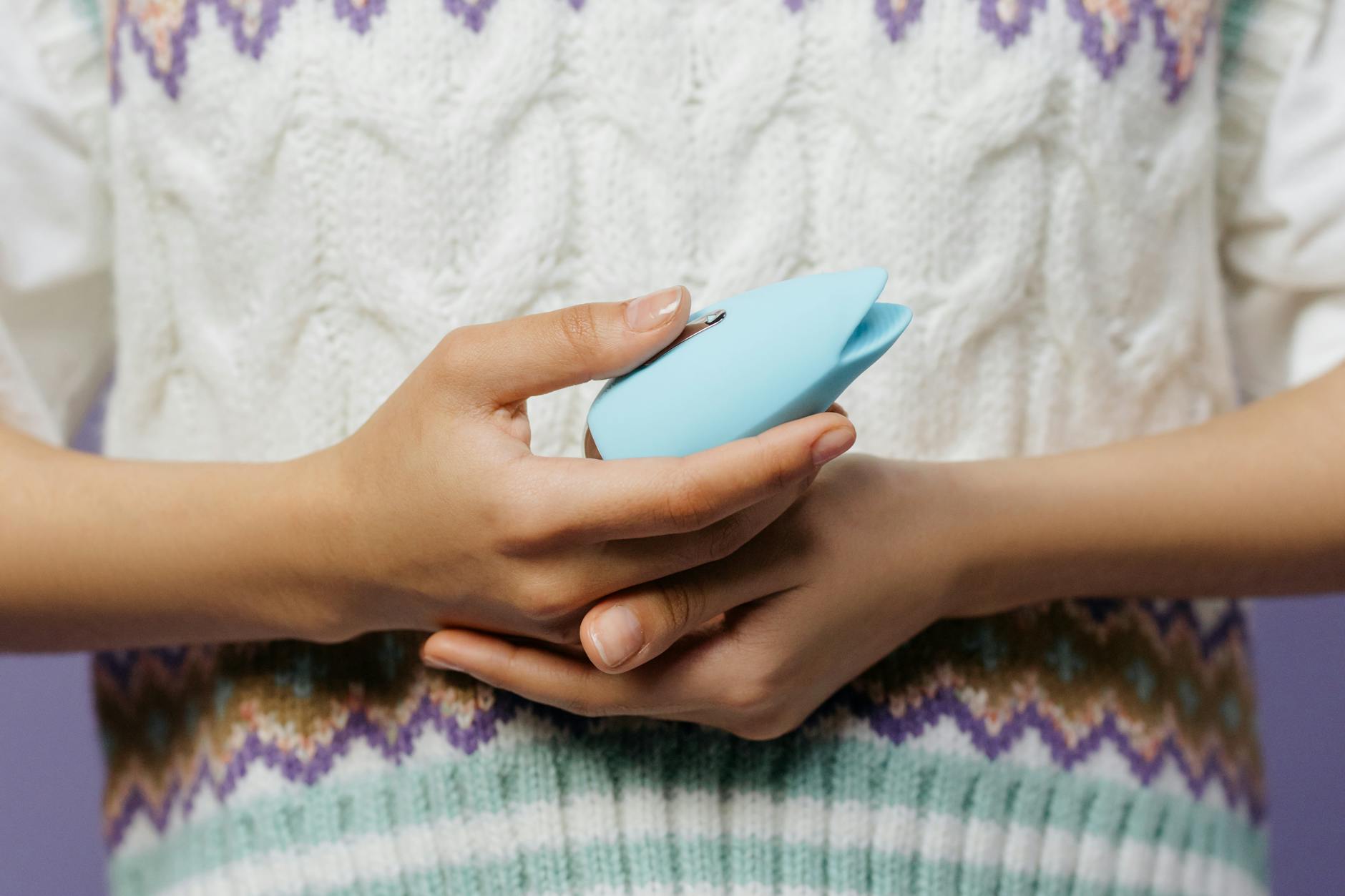
Photo by cottonbro studio on Pexels
When anxiety shows up mid-arousal (and how to handle it)
Sometimes the anxiety hits after you've already started. Your partner initiates or you're 10 minutes in and suddenly your brain floods with "Am I doing this right?" or "What if I can't come?" or just a loop of random worries.
Stop. Not permanently. Just pause.
Keep your lemon vibrator on a low pattern and take five deep breaths. Don't breathe to "relax." Breathe to shift your autonomic state. Slower exhales than inhales actually signal safety to your nervous system. Then resume. You haven't failed. You've reset.
If you're with a partner, you can say this out loud: "I'm getting in my head. Can we just stay here for a minute?" That's it. You don't need to explain the anxiety or fix it. You're telling your partner what you need, which is actually a vulnerability that often deepens connection.
The partnered version (when anxiety affects both of you)
Often, one person's anxiety becomes a couple's problem. One partner is anxious, so the other partner becomes hypervigilant ("Are they okay?"). That kills spontaneity and pleasure for both.
A lemon clitoral vibrator can actually help this. Here's why: it gives the anxious person a tool that doesn't require performance or explanation. You can use it solo or partnered. You can use it to warm up before partnered sex. You can use it because it feels good, not because you're trying to prove you're "fixed."
For the partner who's observing the anxiety: understanding that it's a nervous system state, not a preference, helps. You're not doing something wrong. Your partner isn't broken. Their body is just stuck in a particular gear. That lemon vibrator is helping them downshift.
Building arousal capacity when anxiety is chronic
If your anxiety is constant (not situational), using a lemon sucker regularly actually trains your nervous system over time. You're not forcing arousal. You're proving to your body, through repetition, that sensation is safe and available.
Start small. Five minutes, two or three times a week. No pressure for orgasm. Just sensation. Over time, your body recognizes "Oh, this is a safe window" more quickly. Your arousal response gets faster. Your anxiety during those windows gets quieter.
This is nervous system retraining, not psychological fixing. But it works because you're giving your body evidence through direct experience.
When you need professional support too
If anxiety is preventing arousal consistently, a therapist (especially one trained in somatic therapy or sex therapy) is worth considering. A lemon vibrator is a useful tool. It's not therapy. A tool plus professional support is the most reliable path.
The same goes if you're managing anxiety with medication. That's fine and often necessary. Some medications do affect arousal, and that's a conversation with your prescriber. A lemon clitoral vibrator can sometimes help compensate, but it's not a replacement for addressing the medication side effect directly.
FAQ: Anxiety and lemon vibrators
Can using a lemon vibrator actually reduce anxiety long-term?
Not directly. A lemon clitoral vibrator is helping your nervous system shift gears temporarily. That's valuable and real, but it's not treating underlying anxiety. What it does is prove to your body that pleasure is still available, which can counter the hopelessness that anxiety sometimes creates. For lasting change with chronic anxiety, therapy or medication (or both) is the real foundation.
What if I feel guilty or weird using a vibrator because of my anxiety?
That guilt is often part of the anxiety itself. Anxiety loves to tell you that you're doing everything wrong, including things that feel good. A therapist can help you separate the voice of anxiety from actual values. Using a lemon sucker isn't selfish or wrong. It's you taking your pleasure and your nervous system seriously.
Should I tell my partner I'm using a lemon vibrator because of anxiety?
That's your call, but here's what often helps: if you're using it to manage something that affects both of you (like arousal loss), sharing it can actually open a conversation about what you both need. You don't have to confess or justify. You can simply say, "I'm working on something that's been getting in the way of us connecting." That honesty often brings partners closer.
How long does it take for a lemon vibrator to help with anxiety-related arousal loss?
Some people feel a shift in the first session. For others, it takes two to three weeks of regular use before the nervous system recognizes the pattern. Consistency matters more than intensity. A few minutes several times a week beats marathon sessions once a month.
Can anxiety come back even after the lemon vibrator helps?
Yes. Anxiety isn't linear. You might feel great, then have a stressful week and find arousal locked down again. That doesn't mean you've failed or that the tool stopped working. It means your nervous system needs resetting again. That's normal. Have the tool ready and use it.
Is there a "best" lemon vibrator for anxiety-related arousal issues?
The key is something with a low, steady setting. The suction pattern of the lemon clitoral vibrator works well because it builds gradually and doesn't require guessing about intensity. If you're in your head with anxiety, you want the toy to do the thinking for you. Simplicity helps.
The real thing about anxiety and arousal
Anxiety isn't a character flaw or a sign that something's wrong with your capacity for pleasure. It's a nervous system response to a world that often asks you to be constantly on guard. Using a tool like a lemon vibrator to interrupt that pattern isn't cheating or avoiding the deeper work. It's meeting your body where it actually is right now.
Your pleasure matters. Your nervous system deserves rest. A lemon sucker can help you get there. And yes, you also might need therapy or medication or lifestyle changes. All of those things can coexist. Your job is just to pick the tool that helps you feel something good in this moment, whatever else is true about the anxiety.
If anxiety is consistently interfering with your ability to connect with your body or your partner, reaching out to a relationship coach or therapist can help you build a more personalized plan. There's no shame in asking for support. There's just you, trying to feel good, and that matters.